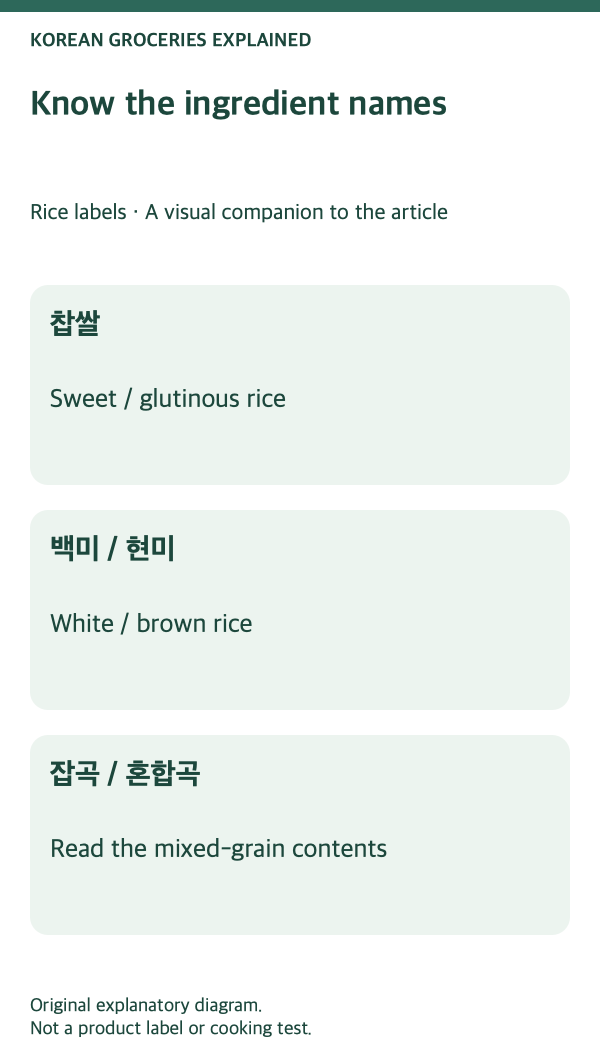
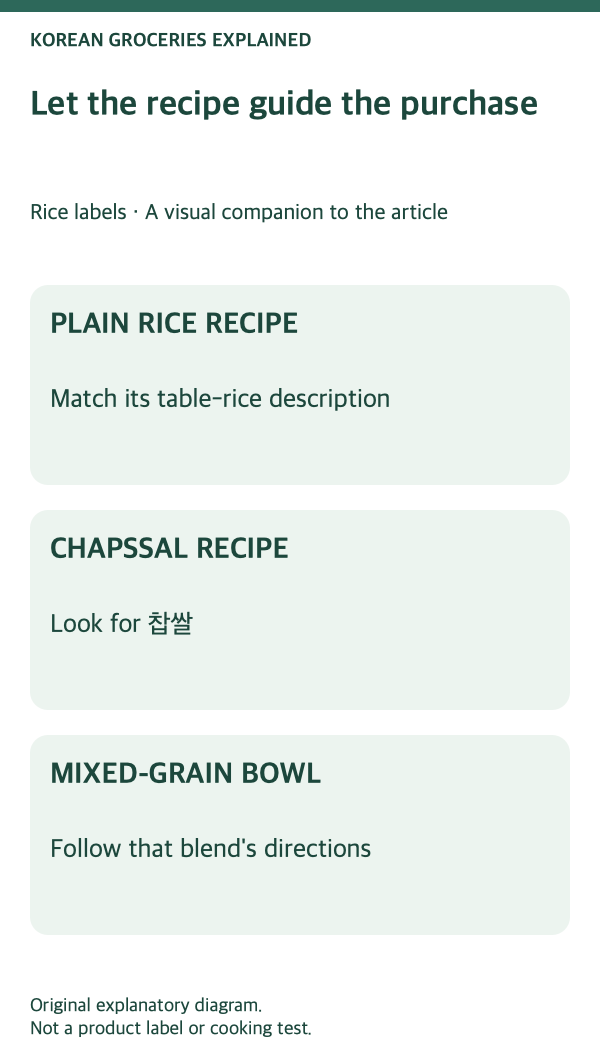
For an everyday bowl of Korean-style white rice, begin with the plain short-grain rice requested by your recipe. Choose 찹쌀 (chapssal) when the recipe specifically asks for sweet or glutinous rice. For a mixed-grain bowl, check the contents and cooking directions of the 잡곡 (japgok) or 혼합곡 (honhapgok) product before buying.
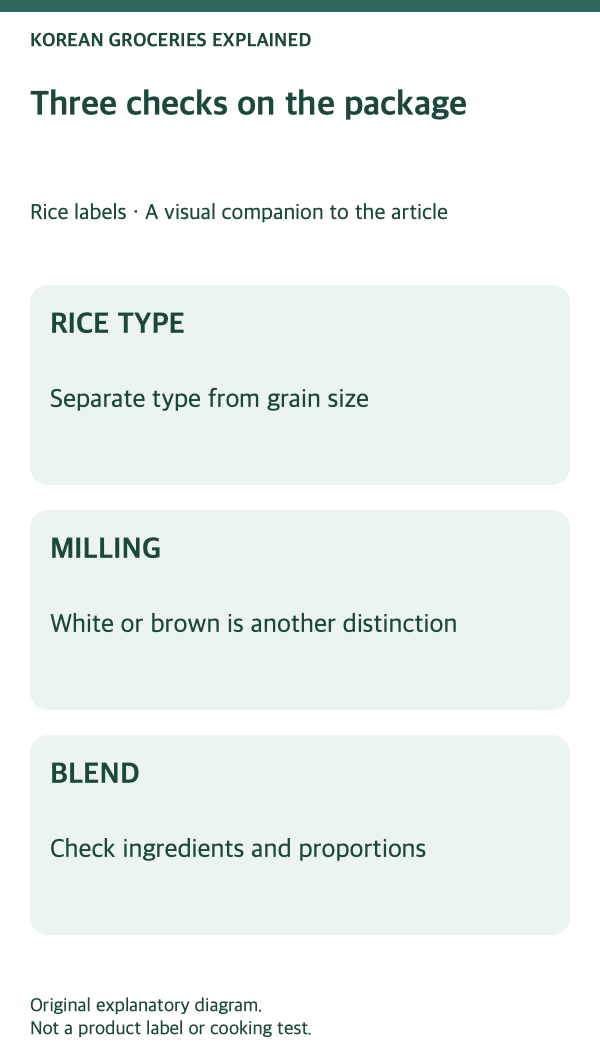
The key is to separate three questions: what kind of rice it is, how it has been milled, and whether other grains have been mixed in. A bag can answer more than one of those questions at once.
Short-grain does not mean sweet rice
“Short-grain” describes grain size. “Sweet rice” identifies a particular rice type, also called glutinous rice. Both ordinary short-grain rice and short-grain sweet rice can have short, plump kernels, so shape alone is an unreliable way to choose between them. USA Rice's guide to rice varieties distinguishes kernel size, milling and sweet rice rather than treating them as one classification.
Calrose is medium-grain, even if a shop displays it beside short-grain rice. USA Rice describes its cooked texture as moist and slightly sticky. Read the actual grain description rather than guessing from the brand name.
Chapssal: buy it when the recipe asks for it
찹쌀, commonly translated as “sweet rice” or “glutinous rice,” is different from 멥쌀 (mepssal), non-glutinous rice. The National Institute of Korean Language explains the contrast between these Korean words.
“Sweet rice” is a rice name, not an instruction to add sugar. For a concrete example, the producer describes Sho-Chiku-Bai Sweet Rice as plain rice with no additives and a notably sticky cooked texture. Its suggested applications include Korean confections, and it distinguishes the product from ordinary table rice.
The shopping lesson is simple: do not replace an entire bag of ordinary rice with chapssal just because you want the finished rice to hold together. Buy chapssal for a recipe that names it, or for a blend whose proportions and cooking method are already specified.
Baekmi and hyeonmi describe another difference
백미 (baekmi) means white rice; 현미 (hyeonmi) means brown rice. Brown rice retains its bran layer, while white rice has been milled further. This distinction is separate from grain length. USA Rice's milling guide
You may even see 현미 찹쌀, brown sweet rice. That combination is not contradictory: one part identifies the milling form and another identifies the rice type. The expression also appears in the National Institute of Korean Language's entry for hyeonmi.
Mixed grains: read the blend, not just the number
A mixed-grain product is a shopping category, not one fixed recipe. Check the ingredient list rather than assuming that two bags with the same number of grains contain the same mixture.
CJ's explanation of its Hetbahn mixed-grain range discusses brown rice, black rice and barley, and notes that different grains require attention to soaking and proportions. It describes prepared rice products, so those instructions should not be copied as a cooking method for an unrelated raw grain blend.
Before choosing a dry blend, find out whether it is intended to be cooked on its own or added to white rice. Then locate the recommended proportion, soaking instructions and cooking method. If those details are missing from an online listing, request a readable back-label photo before ordering.
A decision aid for your first rice purchase
| Your plan | What to look for | What to confirm |
|---|---|---|
| Make the plain rice in your chosen recipe | The requested short- or medium-grain table rice | That it is not sweet rice or an already seasoned product |
| Make a dish that names chapssal | 찹쌀; sweet or glutinous rice | Whether the recipe needs whole grains or rice flour |
| Make brown rice | 현미; brown rice | Directions written for that rice and your cooking equipment |
| Try a mixed-grain bowl | 잡곡 / 혼합곡 | Ingredients, whether to add white rice, and preparation directions |
| Buy something to heat quickly | A clearly identified cooked-rice product | Heating instructions, rather than a raw-rice cooking ratio |
Keep these four details with the recipe
For a repeatable shopping list, record the full product name, whether it is raw or cooked, the grain or blend description, and the preparation instructions. A photograph of both sides of the package is often easier than translating a long brand name later.
Follow the directions for the rice and your cooker instead of applying one water ratio to every bag. Check the current ingredients and allergen information whenever a dietary restriction matters, especially for blends. The word “rice” on the front does not describe every ingredient in a mixed or seasoned product.
Sources checked October 13, 2026. Product examples explain label differences; they are not brand rankings. Follow the current package if its formulation or directions differ.