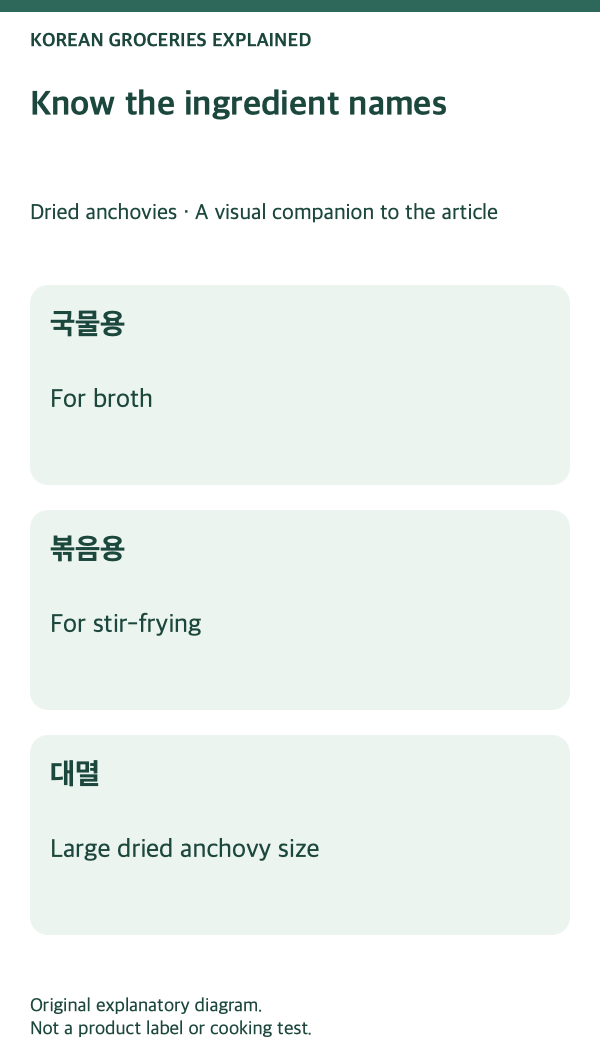
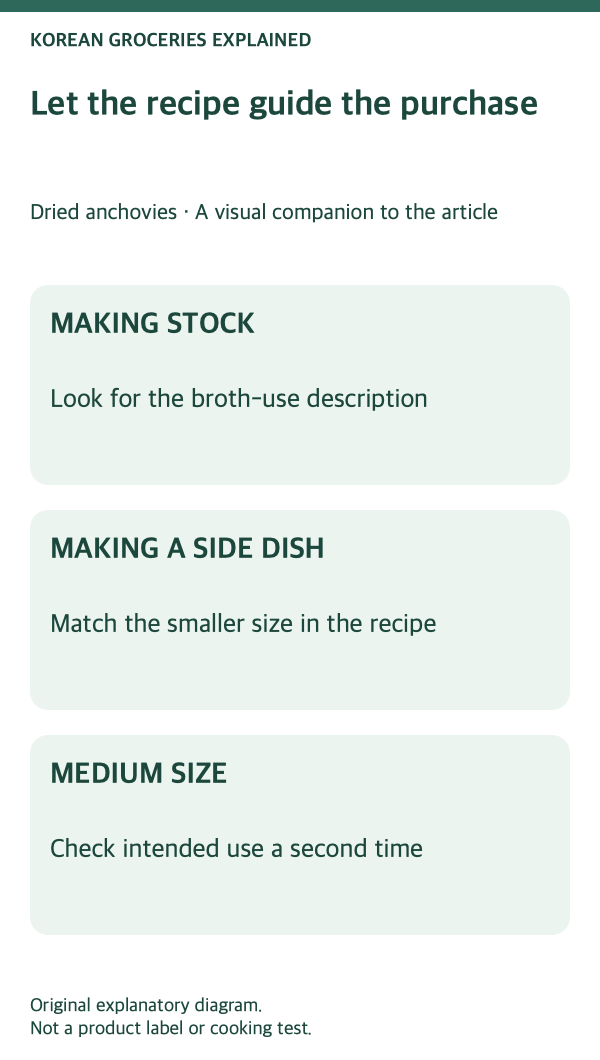
For Korean anchovy stock, start with dried anchovies labeled 국물용, meaning “for broth,” or 대멸, the large size. For a stir-fried anchovy side dish, choose the smaller anchovies specified by the recipe and look for 볶음용, meaning “for stir-frying.”
Size helps you narrow the shelf, but intended use is the more practical first check. Korea's National Fishery Products Quality Management Service guide explains that smaller through medium anchovies are commonly used for side dishes, while large anchovies are commonly used for broth.
Start with the finished dish
Ask whether the anchovies will remain in the food you serve or be used to make a strained broth. That question prevents a common shopping mismatch: bringing home a bag of large stock anchovies for a recipe pictured with tiny whole fish.
For 멸치볶음 (myeolchi-bokkeum), read the recipe's size description. “Small dried anchovies” is a more useful shopping instruction than “anchovies” alone. For broth, copy the recipe's stock-anchovy wording and any preparation notes.
Neither choice is a quality ranking. You are choosing an ingredient for a cooking method.
Recognize the size names
These are useful shelf terms, ordered broadly from smaller to larger:
| Korean term | Romanization | Shopping clue |
|---|---|---|
| 세멸 | semyeol | Very small anchovies; check the package's suggested use |
| 자멸 | jamyeol | A small grade |
| 소멸 | somyeol | Small anchovies |
| 중멸 | jungmyeol | Medium anchovies; read the stated use |
| 대멸 | daemyeol | Large anchovies, commonly used for stock |
The names appear in the Namhae Tongtong anchovy seller's own range, alongside terms such as 지리 and 고바. This is a real example of how several names can appear on the same product listing.
Do not rely on an English “small,” “medium” or “large” label as a universal centimeter measurement. Compare the seller's stated dimensions or a scale photo when an exact size matters. The guide here deliberately avoids imposing one measurement chart on every overseas package.
Medium anchovies need a second look
A medium-size bag is not automatically the wrong choice for a side dish. The government fisheries guide includes medium anchovies among those used for banchan. That makes the intended dish more useful than an assumption that only the very smallest anchovies belong in a side dish.
Prioritize the recipe and use label. If a recipe specifies medium anchovies, do not silently replace them with the tiniest available grade and assume its preparation steps remain identical.
Whole anchovies, stock packs and broth tablets differ
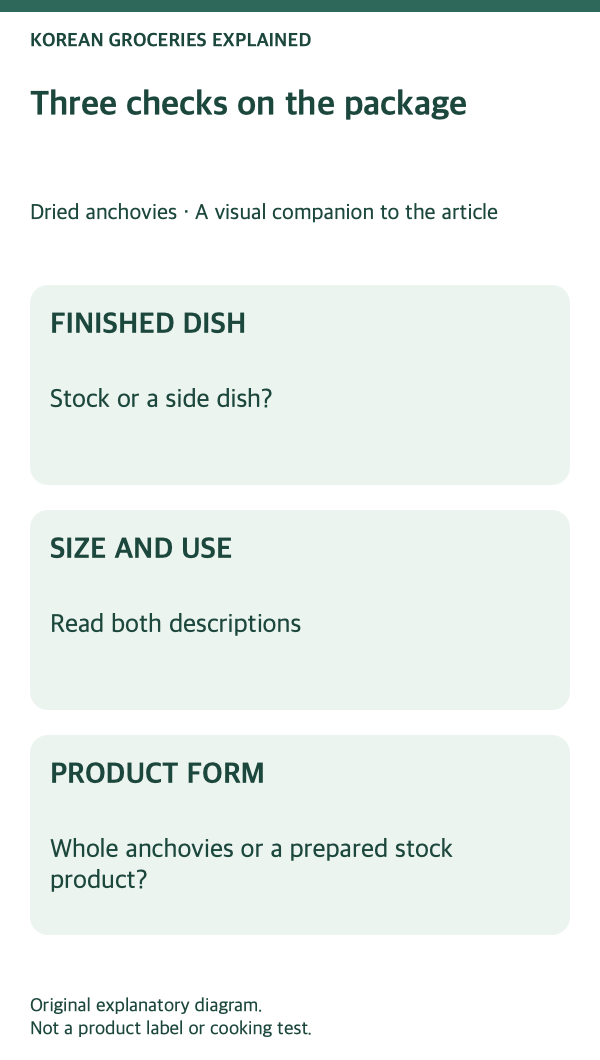
A package with an anchovy picture may be a prepared stock product rather than loose dried fish. Read whether you are buying whole anchovies, an infusion pack or a dissolving broth product.
For example, Sempio's Yondu Ring range includes an anchovy-and-dipori stock product in ring form. That is a formulated broth ingredient with its own directions, not another size grade of dried anchovy.
If your recipe asks for a number or weight of whole dried anchovies, do not translate it into the same weight of broth tablets. Use the prepared product's dilution instructions or a recipe written for it. Check every ingredient when seafood or other dietary restrictions matter.
A three-step buying check
- Copy the ingredient precisely. Record “small dried anchovies for stir-frying” or “large dried anchovies for stock,” rather than only “anchovies.”
- Check the actual product form. Confirm that the listing is for loose dried fish if that is what your recipe requires. Make sure a photograph shows the selected size, not a different option on the page.
- Read the preparation and storage instructions. Check whether the fish are already cleaned and whether the recipe calls for removing heads or interiors. Follow that recipe's method instead of applying one preparation rule to every size.
If an online listing does not provide a readable label, ask the seller for the intended use and approximate fish length. Those two details are more actionable than a promise that the product is “premium.”
Buy around the dish you plan to cook first. A stock bag and a side-dish bag can both be useful later, but there is no need to buy every grade to get started.
Sources checked October 13, 2026. Size terms are presented as shopping guidance, not a universal grading specification. Follow the current product label for ingredients and storage.