Choose vinegar by the recipe’s full description, then check seasoning and strength on the bottle. A rice or apple name does not tell you whether sugar or salt has been added, and a bottle marked 2배 should not be treated as an ordinary-strength vinegar without reading its directions. On a Korean shelf, start with 식초 (sikcho, vinegar), then read the words around it.
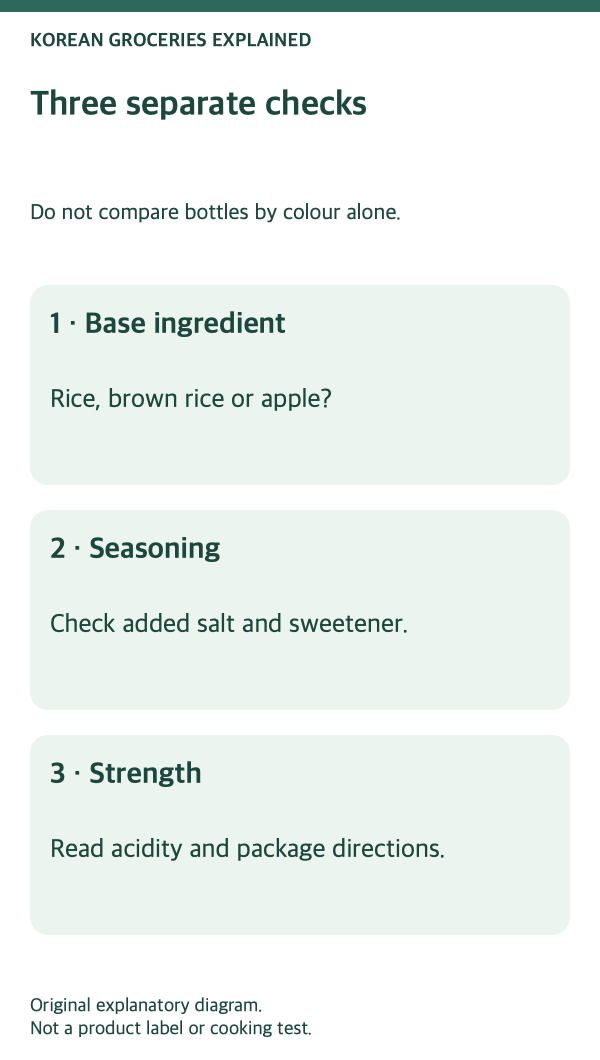
A useful shopping note has three fields: base ingredient, added seasoning, and stated acidity or strength. Keep them separate. This makes the label easier to compare even when two bottles have a similar colour or the same brand name.
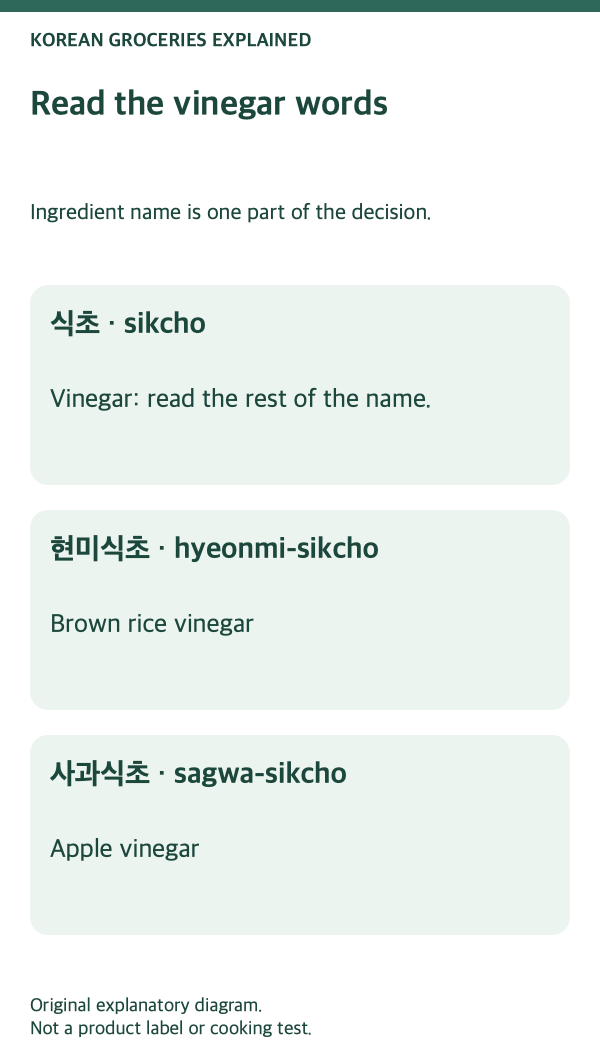
Translate the ingredient name first
현미식초 (hyeonmi-sikcho) means brown rice vinegar; 사과식초 (sagwa-sikcho) means apple vinegar. These words help identify the kind of vinegar being sold. They are not a complete ingredient list or a promise that every brand uses the same ingredients. Photograph the back panel as well as the front name when shopping online or asking someone to buy a bottle for you.
Seasoned rice vinegar is a separate check
Mizkan’s Nakano food-service page lists a natural rice vinegar at 4.2% acidity and a seasoned version at 4%. It describes salt and sweetener in the seasoned product. These are specifications for those particular products, not standard acidity values for every rice vinegar sold in Korea.
If your recipe specifies unseasoned rice vinegar, choosing a seasoned bottle changes more than the word on the front. Check its ingredients before following a recipe that separately adds sugar and salt. Do not assume that a front label saying “rice” also means “unseasoned.” If the recipe calls for a specific seasoned product, keep that requirement in your shopping note instead of removing it during translation.
Do not overlook 2배 or 3배
배 (bae) is used for a multiple: 2배 reads “two times,” and 3배 reads “three times.” Ottogi’s own vinegar column discusses products with higher acidity, and its research history records the development of double-strength vinegar. A strength marking is therefore a meaningful distinction to check, rather than decoration to ignore.
Use the actual bottle’s acidity statement and preparation guidance. This guide does not give one dilution formula for all concentrated vinegars, or claim that a multiplier tells you the percentage printed on every bottle. If the recipe and bottle do not describe the same strength, choose a matching product or check the directions for that bottle before measuring it out.
A quick comparison at the shelf
| Description | Next question |
|---|---|
| 현미식초 / brown rice vinegar | What are the full ingredients and stated acidity? |
| 사과식초 / apple vinegar | Does this match the kind of vinegar named in the recipe? |
| Seasoned rice vinegar | Which sweeteners and salt are already included? |
| 2배 or 3배 | Does the strength match, and what directions does this bottle give? |
Buy for a dish, not just an empty pantry space
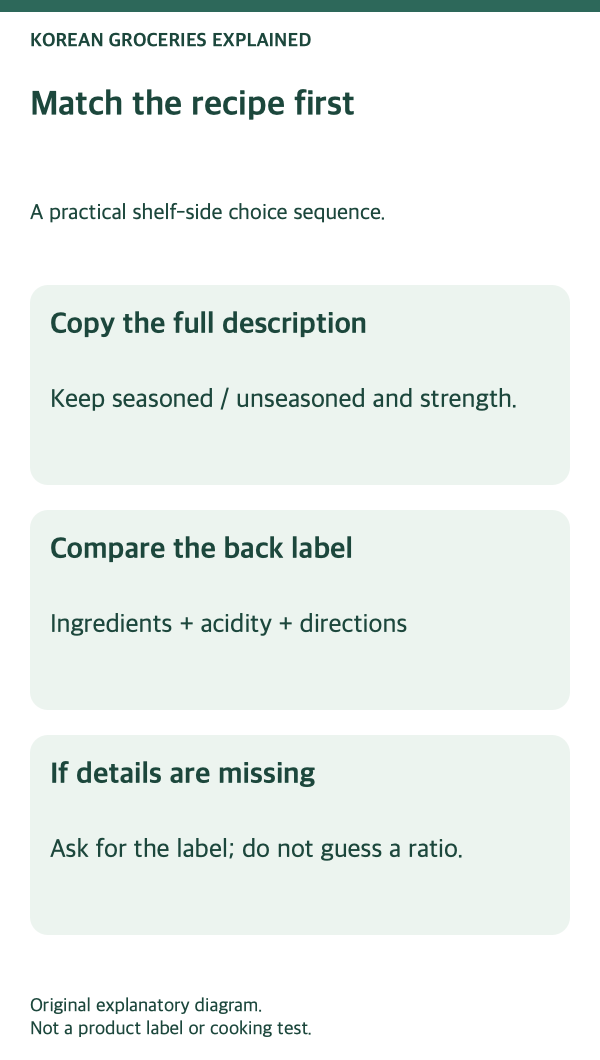
- Copy the whole recipe description. Keep the type, seasoned or unseasoned wording, and any named strength. A note saying only “vinegar” loses useful information.
- Read the back panel. Look for 원재료명 (wonjaeryomyeong, ingredients), 산도 (sando, acidity), and the product’s use and storage directions. Use the current package for the market where you are buying it.
- Ask for missing details. If an online listing has only a front photograph, request a readable ingredient-and-directions image. Do not guess a substitution from bottle colour or a translated listing title.
- Keep the label for repeat purchases. Record the exact product and recipe together. Recheck the label when buying a different size, formulation or market version.
For a complete ingredient list built around a chosen dish, see our first Korean grocery list. If the same shopping list includes noodles, our dangmyeon versus somyeon guide explains that separate package choice. Neither guide replaces your vinegar’s own instructions.
Sources and scope
- Mizkan: Nakano Rice Vinegars — manufacturer specifications for the natural and seasoned examples.
- Ottogi: vinegar cooking column — Korean product terminology and higher-strength vinegar context.
- Ottogi: research laboratory history — manufacturer record of double- and triple-strength vinegar development.
Sources checked October 23, 2026. Product examples illustrate label differences; they are not rankings or personal tasting reviews. This is a shopping guide, not a drinking, health, preservation or canning guide. Follow the current product and recipe instructions.