For visible seeds to sprinkle over a dish, look for 통깨 (tongkkae) and check whether they are roasted. For crushed roasted sesame, look for 깨소금 (kkaesogeum). Despite the word 소금, which means salt, kkaesogeum does not always contain added salt.
A better shopping method is to answer three separate questions: which seed is in the package, whether it has been roasted, and whether it is whole or crushed. Then read the ingredients for added seasoning.
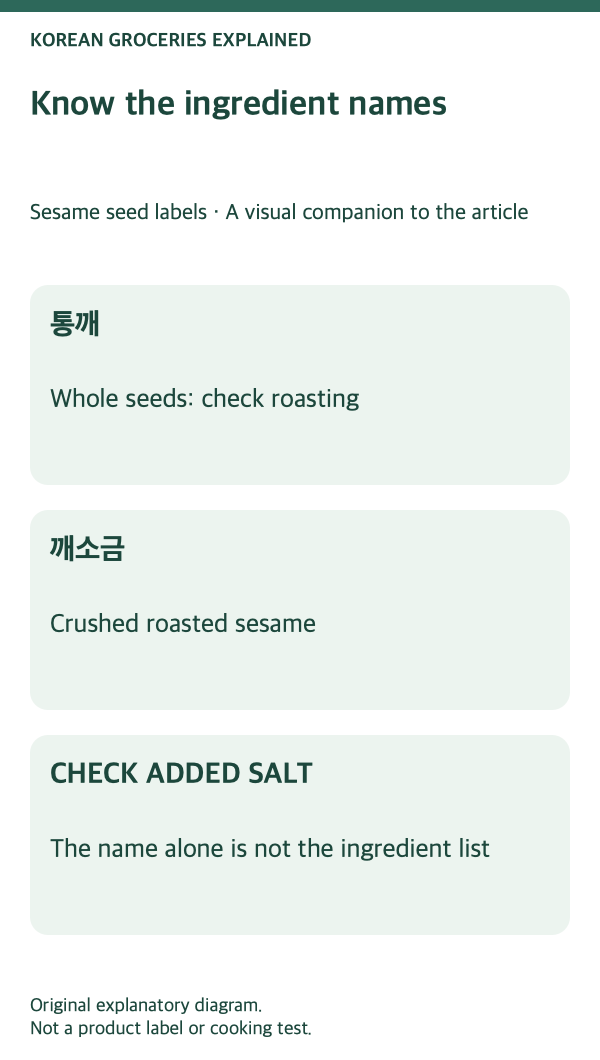
What does kkaesogeum mean?
The National Institute of Korean Language's definition of 깨소금 covers crushed roasted sesame seeds, as well as a seasoning made by adding salt to them. It therefore supports both usages.
This matters when an English label says “sesame salt.” The translation alone cannot tell you how much salt is present, or even whether salt has been added. Look for 소금 or another named salt ingredient in the ingredient list, and use the nutrition panel if you need a sodium figure.
When a recipe asks for kkaesogeum, read its ingredient notes. If the author specifies unsalted crushed sesame, a salted seasoning is not the same ingredient. If the author intends a sesame-and-salt mixture, buying plain seeds does not supply the salt automatically.
Whole, roasted and ground are separate descriptions
Use these words as a small label checklist:
| Korean wording | What it tells you | What it does not settle |
|---|---|---|
| 참깨, chamkkae | Sesame | Whether it is roasted or ground |
| 통깨, tongkkae | Whole sesame seeds | Whether anything else is included |
| 볶음참깨 / 볶은 참깨 | Roasted sesame seeds | Whether the product is whole or crushed; check the description |
| 깨소금, kkaesogeum | Crushed roasted sesame, sometimes with salt | The actual salt content |
| 들깨 / 들깨가루 | Perilla seeds / perilla seed powder | These are different ingredients from sesame |
The distinction between sesame and perilla is visible in Sunvillage's manufacturer product range, which lists sesame, perilla, black sesame, roasted seeds, kkaesogeum and perilla powder separately. A similar-looking powder is not enough evidence that it is the ingredient your recipe wants.
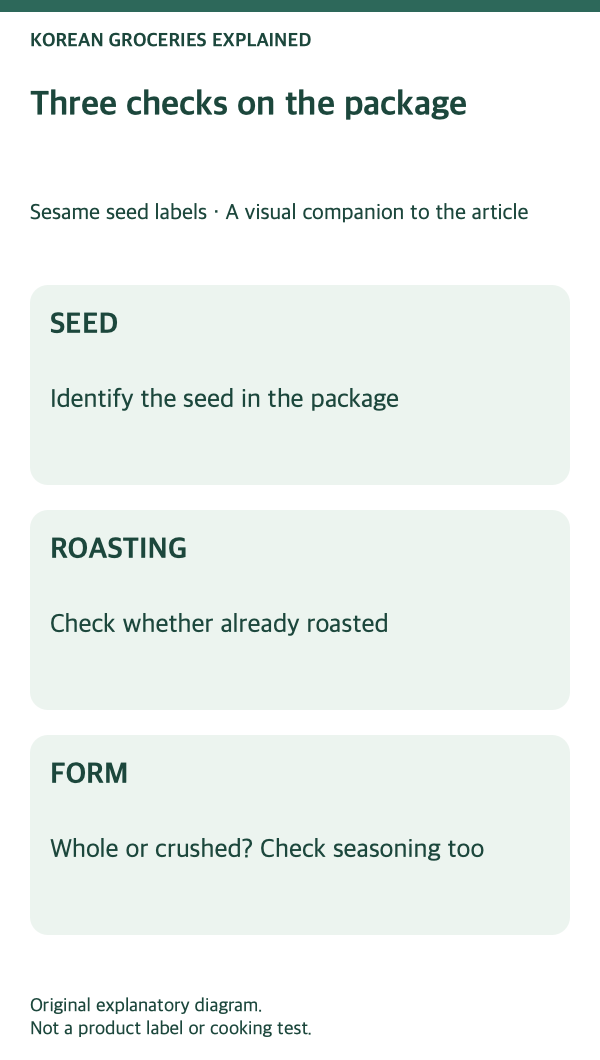
Choose the form for the job
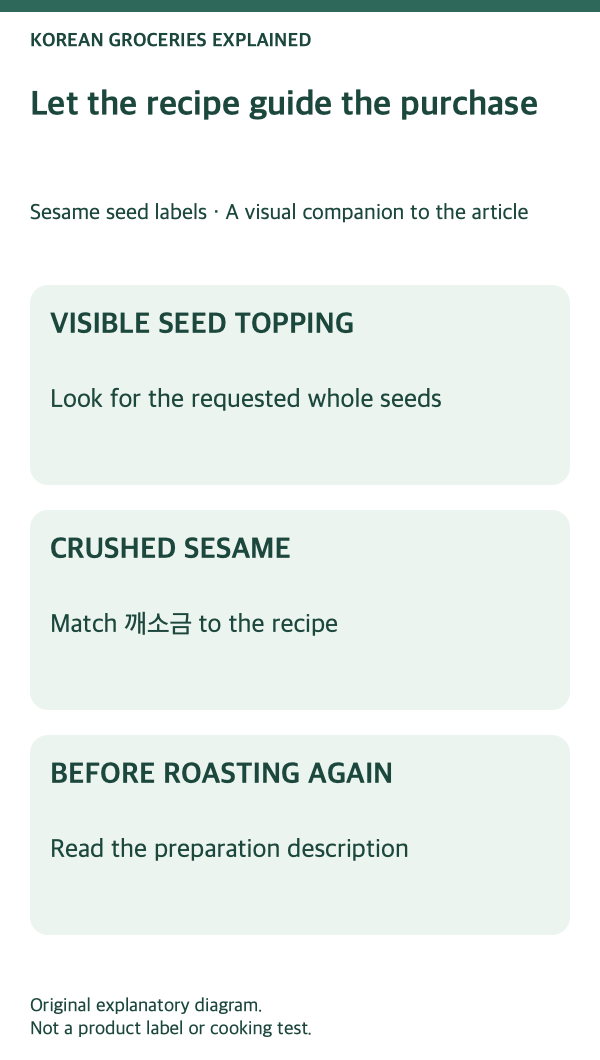
Think about how the seeds appear in your recipe, rather than treating the products as a ranking from basic to premium.
- A visible finishing sprinkle: choose whole seeds in the roasted or unroasted form the recipe specifies.
- Crushed sesame mixed into a seasoning: choose the requested ground product and confirm whether it includes salt.
- A recipe that tells you to crush whole roasted seeds: buy whole roasted seeds and carry out that step yourself.
- A recipe that calls for perilla powder: buy 들깨가루 rather than a sesame product with a similar color.
This is a decision aid, not a substitution chart. If you only have whole seeds, first check whether the recipe expects you to grind them. If you only have a salted sesame mixture, use the author's substitution guidance instead of keeping every other salty seasoning unchanged by default.
Do you need to roast them again?
Start by checking whether the label already says roasted. Sunvillage describes roasting as part of its seed production process, and its range includes roasted seed products. A recipe's instruction to roast raw seeds should not automatically become an extra roasting step for a package that has already undergone that process.
Follow the recipe and package directions for the form you actually bought. The word “whole” describes the state of the seed, not proof that it is raw.
A practical online-shopping check
When a listing's title contains several keywords, inspect the exact variant selected. “Sesame, ground sesame, perilla powder” in a search result may describe several options on one page.
Before ordering, find:
- A readable product name identifying the seed.
- A description or photo confirming whole seeds or powder.
- Roasted or unroasted wording, where relevant.
- The current ingredient list, including any added salt or seasoning.
- Storage directions for that product, including after opening.
Choose a package size that suits the recipes you actually plan to make. Keep the original label if you transfer the contents into a kitchen jar, and mark the jar with the seed, form and seasoning: for example, “roasted whole sesame” or “ground sesame with salt.” That is more informative than simply writing “sesame.”
Sources checked October 13, 2026. Korean dictionary definitions explain terminology; manufacturer examples illustrate product distinctions. Always check the package's current ingredients and allergen information.