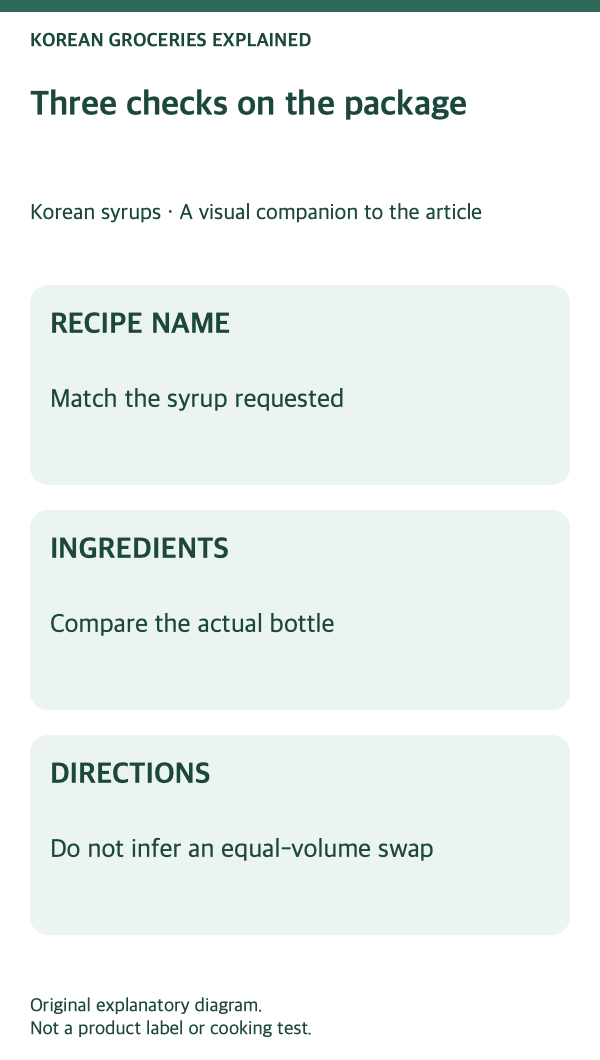
When a Korean recipe names 물엿 (mulyeot), 조청 (jocheong) or 올리고당 (oligodang), begin by matching that name on the bottle. All three appear in the sweetener aisle, but the names do not establish an equal-volume substitution or a single recipe for how every brand makes its product.
For a first purchase, the recipe's requested syrup and the bottle's ingredients are more useful than claims about which syrup is “better.”
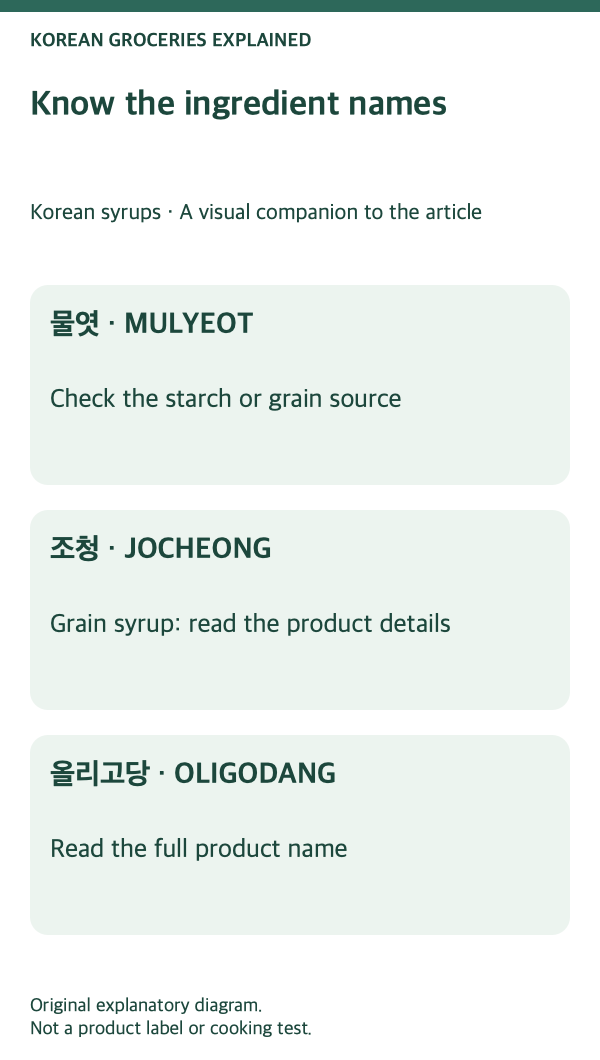
Mulyeot: check the starch or grain source
Mulyeot is a cooking syrup often encountered with English wording such as “corn syrup” or “starch syrup.” For a specific commercial example, Otoki's Korean Corn Syrup is described as made from corn and intended to contribute sweetness and gloss.
The connection is also documented in the Korea Agro-Fisheries & Food Trade Corporation's 2022 sweetener-market report, whose product comparison identifies Otoki's 옛날 물엿 as a corn-starch product. That is evidence about a named product, not a definition requiring all mulyeot to have the same formulation.
At the shelf, match the Korean name and then read 원재료명, the ingredients field. If an overseas recipe specifies a particular Korean syrup, do not select an unrelated flavored syrup merely because both bottles use the English word “syrup.”
Jocheong: a grain-syrup name, with product details to check
The National Institute of Korean Language defines 조청 as yeot that remains fluid rather than being cooked to a solid candy. 쌀조청 (ssal-jocheong) identifies a rice version; you may also encounter rice-syrup wording such as 쌀엿.
For a current product example, Otoki's Korean Rice Syrup is described by its maker as rice-based, brown and aromatic. The food-trade report cited above identifies its 옛날 쌀엿 product as 조청.
Do not use the word jocheong alone to infer a particular barley-malt process, the absence of other ingredients, or a dietary guarantee. Commercial names, source grains and manufacturing details are different pieces of information. Check the maker's description and the current ingredient list when those details affect your choice.
Oligodang: the full product name matters
올리고당 appears in English as “oligosaccharide syrup.” It does not identify one identical syrup across every bottle. In its explanation of its liquid sweeteners, CJ distinguishes fructooligosaccharides and isomaltooligosaccharides. That historical explanation is useful for understanding the terminology, but current packages are the place to verify today's formulation.
The front label may add more words. For instance, Beksul Rice Oligosaccharide Syrup, 쌀올리고당, is a rice-based product that CJ recommends for uses including stir-fried anchovies and braised burdock. It is a useful counterexample to a blanket instruction that every oligodang product must be reserved for uncooked dishes.
A rice-based name also does not automatically turn an oligosaccharide product into the jocheong specified by a recipe. Read the entire name rather than stopping at 쌀, “rice.”
Use this label checklist
| Wording | What to check next |
|---|---|
| 물엿, mulyeot | Source ingredient and whether it matches the recipe's syrup |
| 조청, jocheong | Grain, full ingredient list and the manufacturer's description |
| 쌀조청 / 쌀엿 | Whether the rice-syrup product is the style requested |
| 올리고당, oligodang | Full product name, ingredients and cooking guidance |
| 원재료명 | Ingredients, including any additional sweeteners or flavorings |
| 영양정보 | Nutrition information, compared using the same quantity |
Can you substitute one syrup for another?
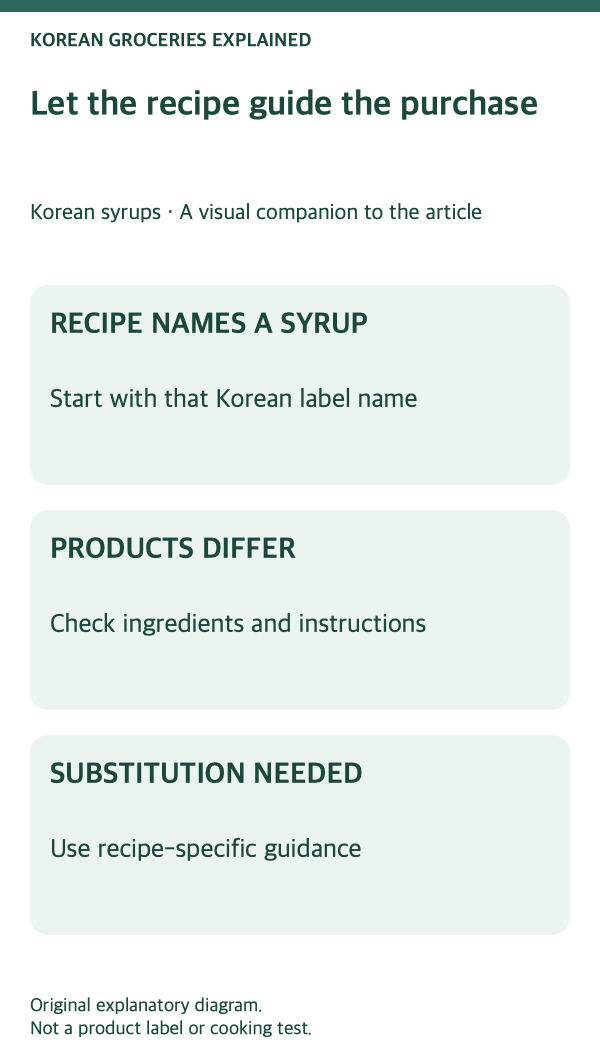
Avoid treating this guide as a universal conversion chart. The manufacturer examples establish different products and intended uses; they do not establish equal sweetness or equal thickness across brands.
Use this order of decisions:
- Check the recipe's named syrup and substitution notes.
- Compare the full label of your bottle with the recommended product.
- If the author provides a substitute, follow that quantity and method.
- If there is no guidance, choose a recipe written for your syrup, especially when the syrup forms a glaze or binds a sweet together.
When comparing nutrition panels, use the same basis, such as grams per 100 grams. Do not compare one bottle's tablespoon serving with another bottle's 100-gram figures as if they represented the same amount. This guide does not rank syrups by health benefit or make a sugar-reduction claim.
For your shopping notes, save the complete product name and a back-label photo. “Rice oligosaccharide syrup” gives you much more useful information on the next trip than “the brown syrup.”
Sources checked October 13, 2026. The 2022 trade report and CJ's 2014 explanation are identified as historical references; current manufacturer pages supply the contemporary examples. Formulations and export labels may differ.