Choose sweet or glutinous rice flour when your recipe calls for 찹쌀가루 (chapssalgaru). Choose the specified ordinary rice flour when it calls for 멥쌀가루 (mepssalgaru). Do not treat every bag marked “rice flour” as the same ingredient. First match the rice type, then check the product form and the recipe directions. A similar-looking white powder is not enough evidence for a substitution.
This guide is for shopping and reading labels. It does not provide a tested rice-cake recipe or a universal flour-to-water ratio.
Read the rice word before the brand name
찹쌀 (chapssal) means sweet or glutinous rice; 멥쌀 (mepssal) distinguishes ordinary, non-glutinous rice. The National Institute of Korean Language explains the Korean spelling contrast and associates 찰- with stickiness. Adding 가루 (garu, powder or flour) gives the flour names shoppers encounter. The broad label 쌀가루 (ssalgaru, rice flour) still needs a closer look: find the rice description and ingredient list.
For whole grains rather than flour, see our Korean rice label guide. This article addresses the separate decision of buying a milled ingredient for a recipe.
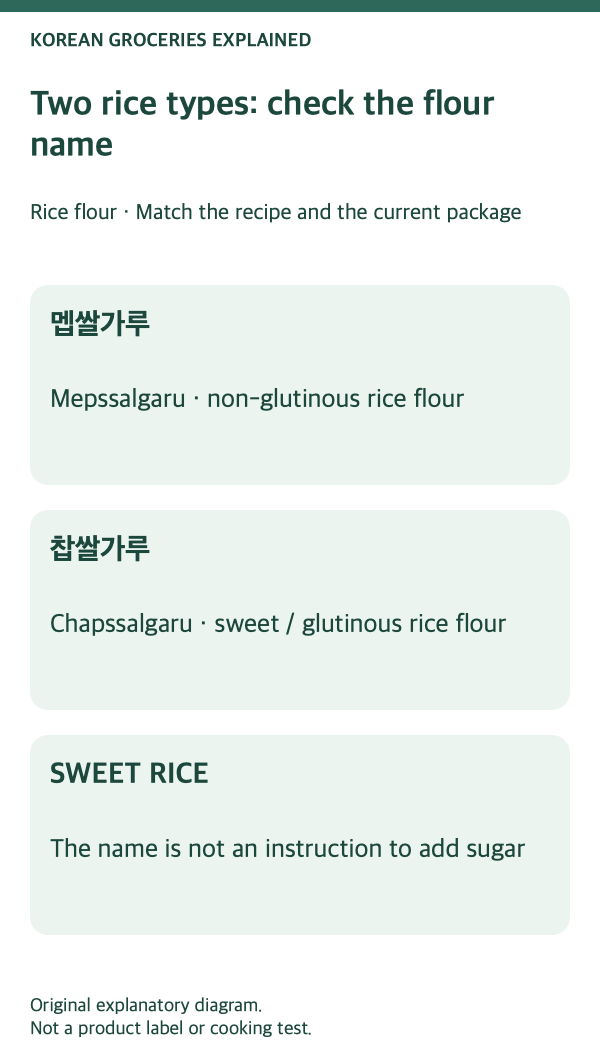
Compare the labels that matter
| Label wording | What it tells you | Next check |
|---|---|---|
| 찹쌀가루 / sweet rice flour / glutinous rice flour | Identifies the sweet-rice type | Does the recipe ask for this exact type and product form? |
| 멥쌀가루 / non-glutinous rice flour | Distinguishes the ordinary rice type | Does the package match the recipe’s milling or preparation description? |
| 쌀가루 / rice flour | A broad rice-flour description | Look beyond the front name for the rice type and ingredients |
| Rice-cake mix | A prepared product description | Read the complete ingredients and its own directions; do not assume plain flour |
“Sweet” is not a sugar instruction
Bob’s Red Mill describes its Sweet White Rice Flour as milled from glutinous, or sticky, rice. It explicitly distinguishes the name from sugar sweetness. Its product information discusses binding, thickening and mochi applications. These are examples for that manufacturer’s product, not proof that every flour or every Korean rice cake uses the same method.
The same manufacturer sells a separate White Rice Flour and lists uses such as noodles, cookies and thickening sauces. The useful comparison is that one producer labels these as distinct products. Neither page supplies a universal substitution ratio between them. A shared use such as thickening does not establish that they will give identical results in your recipe.
Make the purchase in four checks
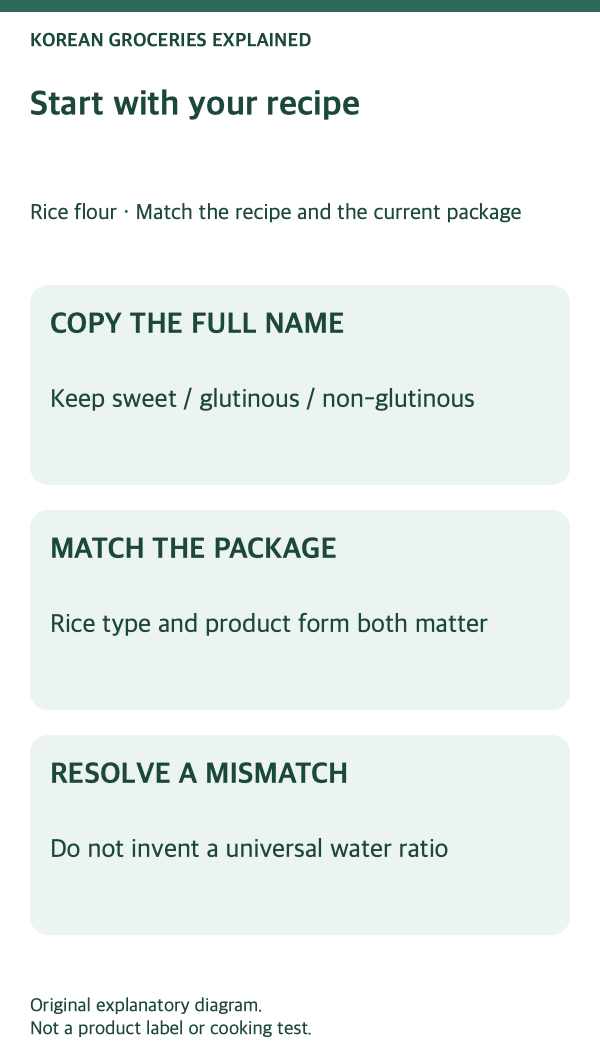
- Copy the full ingredient phrase from your recipe. Keep words such as sweet, glutinous or non-glutinous. Save the Hangul if it is provided.
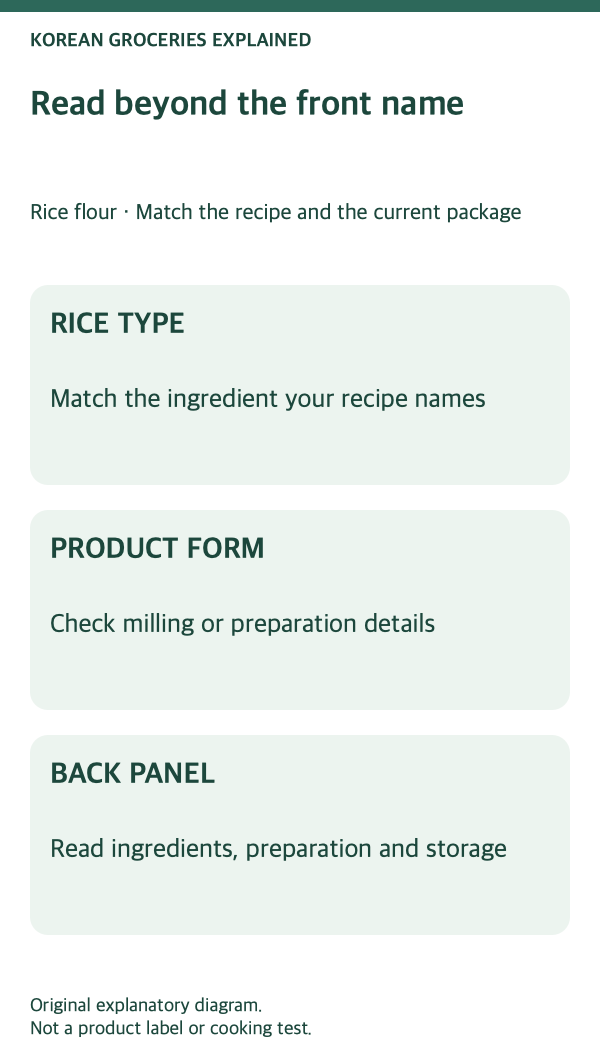
- Compare the full package description. If the recipe specifies a particular milling method, prepared flour or frozen product, ask for that specification rather than selecting by rice type alone.
- Read the back label. Check the ingredients, any added ingredients, preparation directions and storage instructions. Use the current package for your market.
- Resolve a mismatch before cooking. If an online listing omits the back panel, request a readable photograph or choose a recipe written for the product you can actually buy. Do not invent an adjustment by adding a fixed amount of water.
Keep a useful pantry note
Record the exact product name, rice type, package form and the recipe it was purchased for. Keep a photo of the preparation panel. This is more useful for a repeat purchase than a note saying only “rice flour.” Follow the package’s storage and handling directions; this guide does not assign a shelf life. Where dietary requirements matter, read the current ingredient and allergen information rather than relying on a translated front label.
Choose the product category before the flour brand
First decide what your recipe asks you to buy: a bag of flour, a prepared mix, or ready-shaped rice cakes. Compare products within that category, then check the exact rice type and package directions. A familiar dish name on the front does not replace these checks.
- Buying ready-shaped rice cakes? Use the tteokguk and tteokbokki rice-cake guide to compare shape, ingredients and preparation directions. Buying rice cakes is a different decision from choosing flour to make a recipe.
- Buying a savory pancake or frying mix? See buchimgaru versus twigimgaru for the package purpose and ingredient checks. Do not infer that a prepared mix is plain rice flour.
Sources and scope
- National Institute of Korean Language: Korean spelling of 멥쌀 and 찹쌀 — language evidence, not a cooking test.
- Bob’s Red Mill: Sweet White Rice Flour — manufacturer description of its own product.
- Bob’s Red Mill: White Rice Flour — comparison product from the same manufacturer.
Documentation checked October 22, 2026. This is a researched label guide, not a personal cooking, tasting or product-review claim. Product examples are not rankings. Packaging and directions may differ by brand or market.