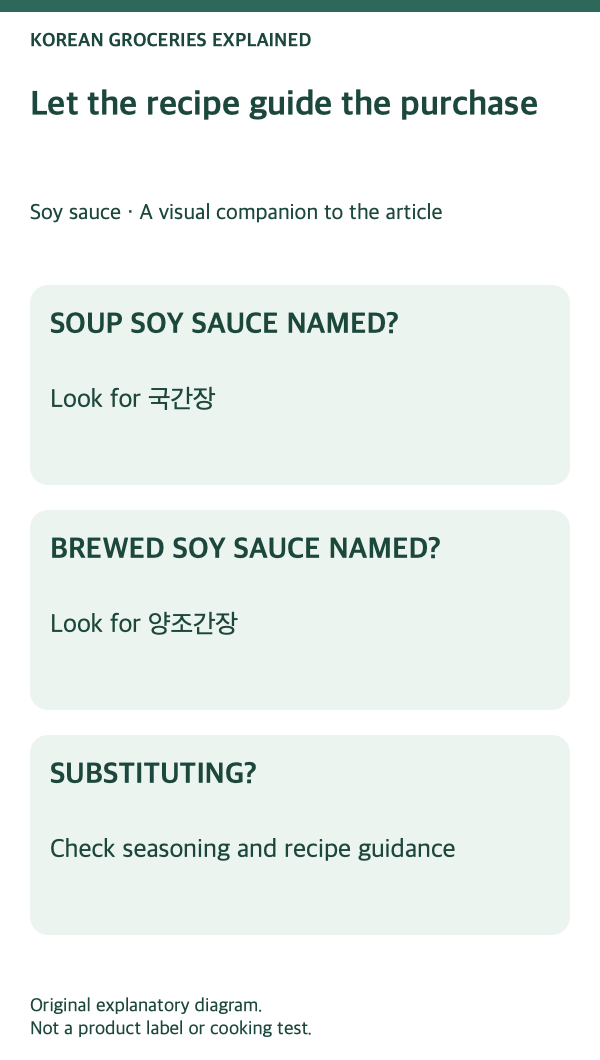
A Korean recipe asks for soy sauce, and the shop has bottles marked 국간장, 진간장 and 양조간장. Which should you choose?
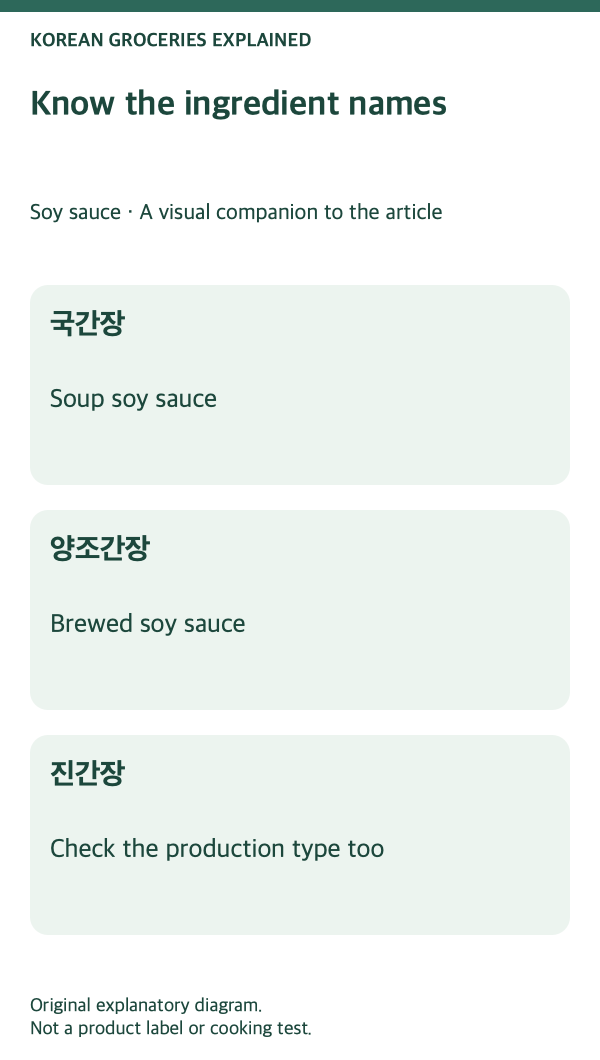
Start with the recipe's exact wording. Guk-ganjang is the name to look for when it specifies Korean soup soy sauce. Yangjo-ganjang means brewed soy sauce and can suit both table sauces and cooking. Jin-ganjang appears on everyday cooking soy sauces, but the name alone does not tell you how a particular bottle was made.
The useful distinction is between what a sauce is intended for and its production category. Those descriptions can overlap, so read the Korean name together with the smaller product information on the bottle.
Which bottle fits the job?
| What your recipe needs | Start by looking for | What to check before buying |
|---|---|---|
| Korean soup soy sauce for a clear broth or seasoned vegetables | 국간장, guk-ganjang; sometimes an English “soy sauce for soup” label | Whether it is plain soy sauce or a seasoned soup sauce |
| Soy sauce for a dipping sauce or dressing | 양조간장, yangjo-ganjang | The ingredient list and the recipe's requested style |
| Soy sauce for braising or stir-frying | 진간장, jin-ganjang, or a brewed soy sauce recommended for cooking | The manufacturer's suggested uses; either name can cover suitable products |
| A specifically named brand or product | That exact product, where available | The full name and formulation, rather than the bottle color |
| An unspecified “soy sauce” | The recipe's ingredient notes first | Whether the author distinguishes ordinary soy sauce from soup soy sauce |
These are starting points, not exclusive uses. Sempio's Korean cooking-use guide illustrates the usual division between soup seasoning, dipping and cooked dishes; individual products can cross those boundaries.
Guk-ganjang: start here for Korean soup soy sauce
국간장, written here as guk-ganjang, points you toward soup seasoning. Traditional-style versions are useful when you want to season a broth without giving it a strongly dark color. They also appear in namul, seasoned vegetable side dishes. For example, Sempio's Chosun soup soy sauce is specifically described for clear soups and namul, with a light color and comparatively high salinity.
Read past the English words “for soup.” Even within one brand, similarly named bottles can differ. Sempio lists wheat in its Soy Sauce for Soup, while its Naturally Brewed Soy Sauce for Soup, Chosun lists water, soybean, salt and alcohol. Those are two separate products.
For a shopping list, copy the full name or save the recipe's product reference. “Soup soy sauce” gets you to the right part of the shelf; the label helps you choose the actual bottle.
Yangjo-ganjang: brewed soy sauce with several uses
양조간장, or yangjo-ganjang, identifies brewed soy sauce. It is a useful option for dipping sauces and dressings, but you can also use suitable products in heated dishes.
For a concrete example, Sempio Naturally Brewed Soy Sauce 501 is made through fermentation, and the manufacturer recommends it for uncooked foods, stews and stir-fried dishes. A rule that reserves all yangjo-ganjang for cold dishes would therefore be too restrictive.
When deciding between two brewed sauces, compare the actual ingredients and suggested uses. The shared word yangjo does not make every formulation identical.
Jin-ganjang: check the production type as well as the name
진간장, or jin-ganjang, is a familiar name on cooking soy sauces. Sempio Jin Gold F3, for example, is recommended by its maker for braised and stir-fried dishes.
The complication is that jin-ganjang does not always mean the same production method. Sempio's explanation of its jin-style blended sauce describes combining brewed and acid-hydrolyzed soy sauces. Meanwhile, SANC's official jin-ganjang range includes a product called 양조 1급 진간장, explicitly described as a naturally fermented brewed soy sauce.
That example matters at the shelf: a bottle can be both jin-ganjang by product name and yangjo-ganjang by production description. To find out which kind you are holding, look for 식품유형, the food-type field, rather than relying on jin alone.
Cooking names and food categories overlap
Korea's Ministry of Food and Drug Safety lists soy sauce categories including 한식간장 (hansik-ganjang, Korean-style soy sauce), 양조간장 (yangjo-ganjang, brewed soy sauce) and 혼합간장 (honhap-ganjang, mixed soy sauce). Its list also includes acid-hydrolyzed and enzyme-hydrolyzed soy sauces. These category terms differ from the way a shop or recipe may group bottles by use. MFDS food-type listing
The same caution applies to guk-ganjang. Although traditional soup soy sauce is often discussed alongside hansik-ganjang, SANC also sells products named 양조 깔끔한 국간장 in its official soup soy sauce range. The word guk tells a shopper about the intended use; it should not be treated as a guarantee of one production category.
For shopping, ask two questions:
- Will this product suit the dish I am making? Check the recipe and the manufacturer's uses.
- What is this particular product? Check its food type and ingredients.
Four useful Korean label fields
You do not need to translate the entire package to make a better comparison. Start with these fields:
| Korean label wording | Meaning | What to do with it |
|---|---|---|
| 식품유형 / 식품의 유형 | Food type | Look for terms such as 양조간장 or 혼합간장 |
| 원재료명 | Ingredients | Check the actual formulation, including added seasonings |
| 나트륨 | Sodium | Compare amounts using the same serving size |
| 보관방법 | Storage instructions | Follow the directions for that bottle, including any instructions after opening |
If shopping online, look for a readable back-label photo or the manufacturer's product information. If an ingredient or dietary restriction matters, use the current package's ingredients and allergen statements, and ask the manufacturer about anything unclear. A style name or a simplified comparison chart cannot confirm a product's suitability.
Can you substitute one for another?
Check the recipe before making an equal-volume swap. A substitution can change the seasoning, color and added flavors. Three checks are especially useful:
1. Compare the sodium amount on the same basis
Here is a specific label comparison, rather than a rule for every brand:
| Product listed by Sempio | Sodium per 15 mL |
|---|---|
| Naturally Brewed Soy Sauce 501 | 940 mg |
| Naturally Brewed Soy Sauce for Soup, Chosun | 1,420 mg |
For these two products, the same volume supplies different amounts of sodium. The comparison explains why an automatic tablespoon-for-tablespoon substitution may change the result. It is not a universal conversion ratio or a dietary recommendation. Check your own bottle, especially if its market or formulation differs.
2. Check for added flavors
A seasoned soup product may already contribute flavors the recipe expects you to add separately. For example, Sempio Seasoning Soy Sauce for Soup contains vegetable and seafood extracts. That makes its role different from simply choosing a plain soy sauce by saltiness.
3. Use the recipe author's substitution notes
If the recipe specifies soup soy sauce, look for an alternative the author has provided. If it specifies an ordinary cooking soy sauce, do not automatically reach for guk-ganjang because both bottles say “soy sauce.” When no guidance is available, choosing a recipe written for the bottle you already own avoids unnecessary guesswork.
What should a beginner buy first?
Choose your first bottle around the next dish you plan to cook. That is more useful than buying all three names at once.
- If your chosen recipe specifies guk-ganjang, buy the requested soup soy sauce or follow its stated substitute.
- If it specifies jin-ganjang or yangjo-ganjang, match that guidance and check the bottle's suggested uses.
- If it only says soy sauce, read the ingredient notes before shopping.
Keep the full product name with your recipe notes. Once you know which bottle a recipe uses, the next shop becomes much easier.
Source information checked and retrieved on October 13, 2026. This guide compares label terminology and manufacturer information. Product examples illustrate differences rather than rank brands; packaging and formulations may change.