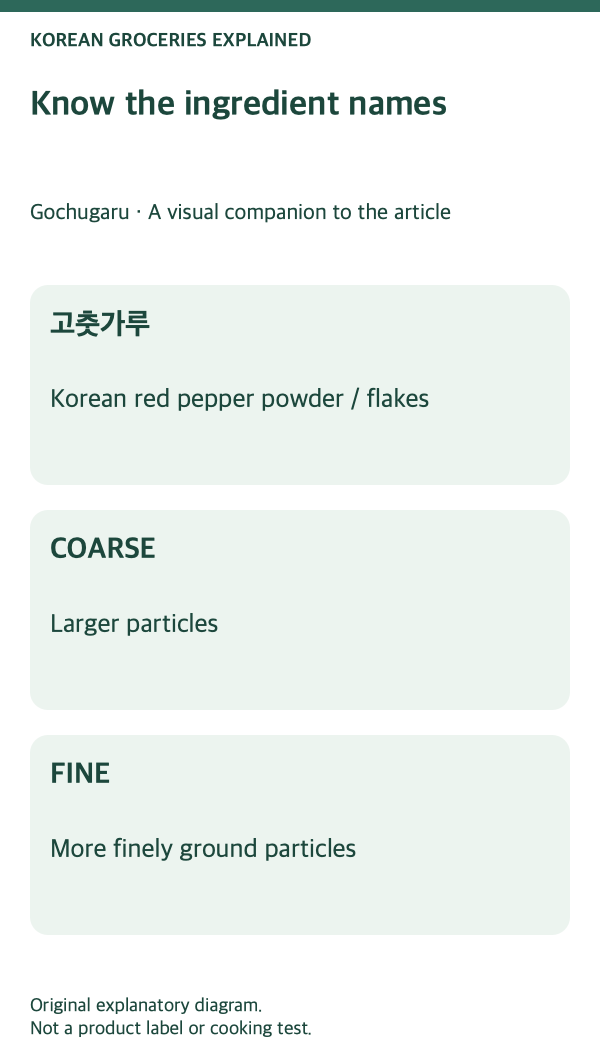
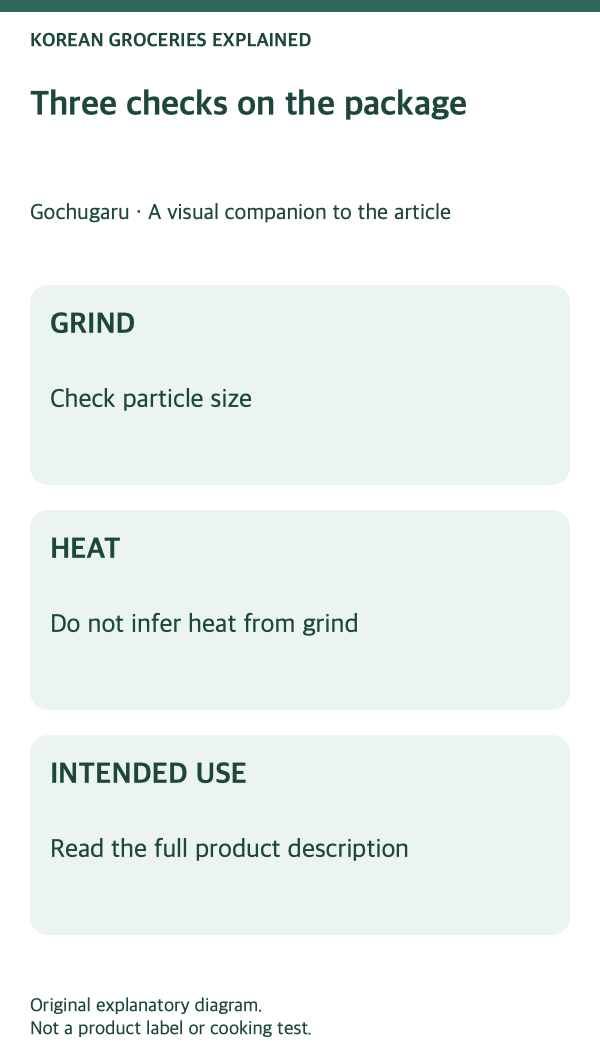
Choose the grind your recipe requests: coarse gochugaru has larger particles, while fine gochugaru is more finely ground. Check heat separately. A fine grind does not, by itself, mean a hotter pepper.
Gochugaru is written 고춧가루 in Korean. You may see both “red pepper powder” and “red pepper flakes” on English labels, so the word powder alone is not enough to identify the grind. Sempio calls both its coarse kimchi product and its fine seasoning product “Red Pepper Powder.”
Read these Korean words first
| Label word | Meaning | What it helps you choose |
|---|---|---|
| 굵은 | Coarse | A larger-particle grind |
| 고운 | Fine | A smaller-particle grind |
| 김치용 | For kimchi | A product marketed for making kimchi |
| 고추장용 | For gochujang | A product marketed for making chili paste |
| 매운 | Hot or spicy | A heat description, rather than a grind |
These are useful clues, not a universal grading system. Dunafarm's manufacturer range separates coarse and fine products and also offers hotter versions. It associates coarse products with kimchi and several cooked dishes, and fine products with uses including gochujang.
Coarse: a starting point when the recipe asks for flakes
For a kimchi recipe that specifies coarse gochugaru, choose a clearly labeled coarse or kimchi-use product. Sempio's Gochugaru for Kimchi is explicitly described as coarsely ground. Its ingredient list identifies red pepper, rather than a complete kimchi seasoning mixture.
That last distinction is worth checking. A bag of pepper is one ingredient; a seasoning mix needs to be used according to its own directions. Before buying, confirm both the grind and what the bag actually contains.
“Kimchi-use” is also a shopping clue rather than a ban on other uses. If your stew or vegetable recipe requests coarse gochugaru, follow that instruction without assuming you need another product simply because the bag mentions kimchi.
Fine: check the intended use, not just the English name
Fine gochugaru is another version of the pepper ingredient. It is not finished gochujang, and buying it does not replace the chili paste listed in a recipe.
Sempio's Gochugaru for Seasoning is labeled finely ground and lists red pepper as its ingredient. The manufacturer also uses that product in its tteokbokki recipe, showing why “fine is only for making gochujang” would be too narrow a rule.
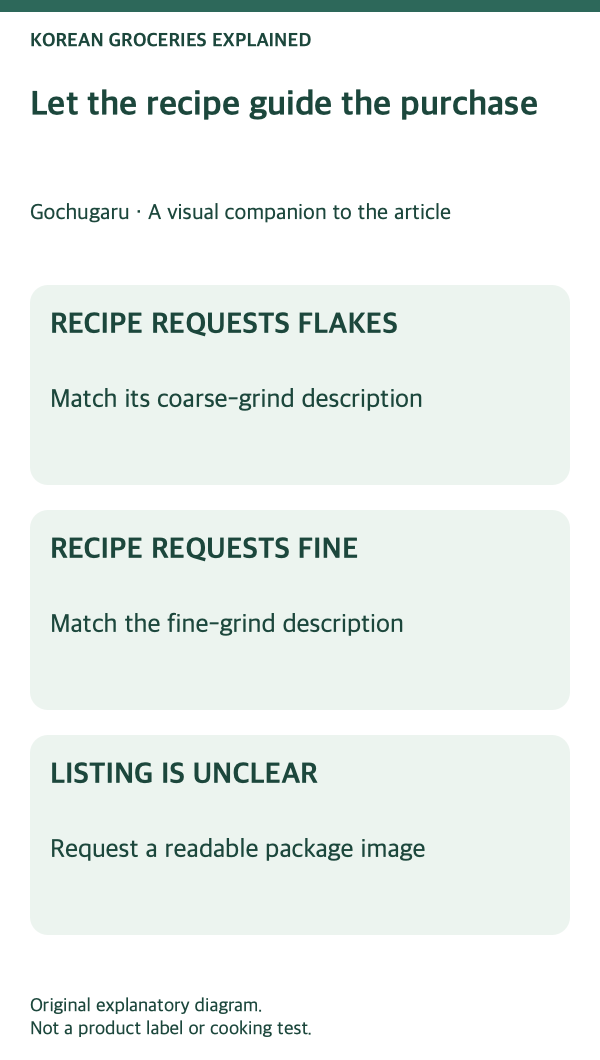
If your recipe calls for fine powder, look for an explicit fine-grind description. If it only says gochugaru, check the author's ingredient notes or accompanying product photograph before choosing.
Grind and heat are two separate decisions
A useful real-world example is the Biggalchan listing supplied by Yeongyang Red Pepper Trade Corporation on K-FOODTRADE. It lists mild, medium and hot pungency options separately from particle sizes for kimchi, sauce and gochujang.
You do not need to memorize the manufacturer's mesh numbers. The practical lesson is to ask two questions:
- Is this the particle size my recipe needs?
- Is this the heat level I want?
Do not use the answer to one as a shortcut for the other.
A worked shopping example
Suppose your recipe says “coarse gochugaru, mild,” and two bags are available:
- Bag A is labeled fine and mild.
- Bag B is labeled coarse and hot.
Neither label matches both requirements. Buying A solves the heat question; buying B solves the grind question. Look for a third option or consult the recipe's substitution guidance instead of assuming one difference does not matter.
This is also why a close-up product photo helps online. Request readable label information if a listing gives only a generic title and a picture of the front of the bag.
What to record for your next purchase
Save the brand, exact product name, grind, heat description and ingredient list. Check the stated origin if that matters to you, rather than inferring it from Korean writing on the package. Choose a quantity that fits your planned recipes and follow that package's storage instructions.
Once you find a product that matches a recipe, keeping those details is more reliable than remembering “the red bag.”
Sources checked on October 13, 2026. Manufacturer examples illustrate label differences; no universal heat scale, grind specification or substitution ratio is implied.